
If your crank handle spins without the window budging, or you're just trying to figure out what makes these windows tick before buying new ones, you're in the right place. Casement crank windows use a geared mechanism to push the sash open like a door, rather than sliding it up or down, and that single difference explains most of what homeowners love and occasionally curse about them.
This article explains exactly how the crank operator mechanism works, from the gear box behind the handle to the arm that pushes the sash outward, and why that design gives casements a tighter seal than sliders once the window is closed. We'll also cover the common wear points that lead to a stiff handle or a sash that won't latch properly.
Beyond the mechanics, we'll walk through what to check before you shop for a casement windows operator replacement, what parts are usually repairable versus what signals it's time for a new window, and where Ontario homeowners can source hardware or get a proper installation. By the end, you'll know exactly what you're dealing with and what to do about it.
Why casement crank windows are worth choosing
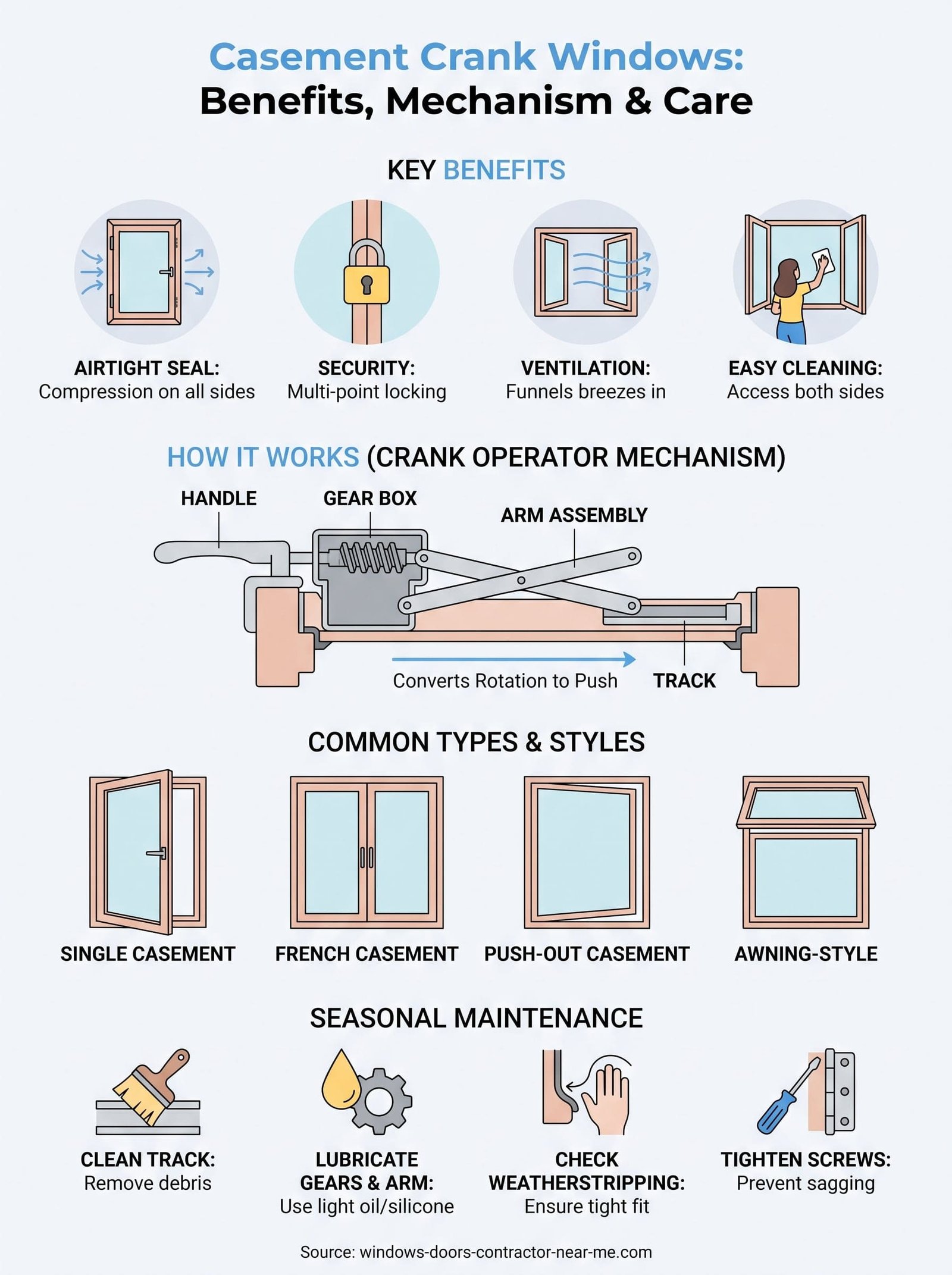
Ask any Ontario homeowner who's lived through a January polar vortex what they think of their casement crank windows, and you'll likely hear the word "airtight" before anything else. Because the sash swings outward and presses against the frame as it closes, the weatherstripping compresses evenly around all four sides, unlike a slider or double-hung window that relies on friction between two moving panels. That wedge-like closing action is the whole reason casements consistently outperform other window styles on air infiltration tests, and it's the main selling point behind their popularity in Canadian new builds and retrofits alike.
A casement window seals itself shut with wind pressure instead of fighting it.
Energy performance isn't just a comfort issue, it shows up directly on your heating bill. Natural Resources Canada notes that windows and doors can account for a significant share of a home's heat loss, and the tighter the seal, the less that matters. Pair a well-fitted casement with Low-E glass and an argon gas fill, both standard on quality Canadian-made units, and you get a window that resists both winter draughts and summer heat gain.
Security and ventilation benefits
Beyond thermal performance, the same mechanical design that seals casements so well also makes them harder to force open from outside. There's no sash to jimmy up from the bottom, and the multi-point locking hardware built into most crank operators engages the frame at several points rather than one. Homeowners in bungalows and ground-floor bedrooms often prefer casements for exactly this reason.
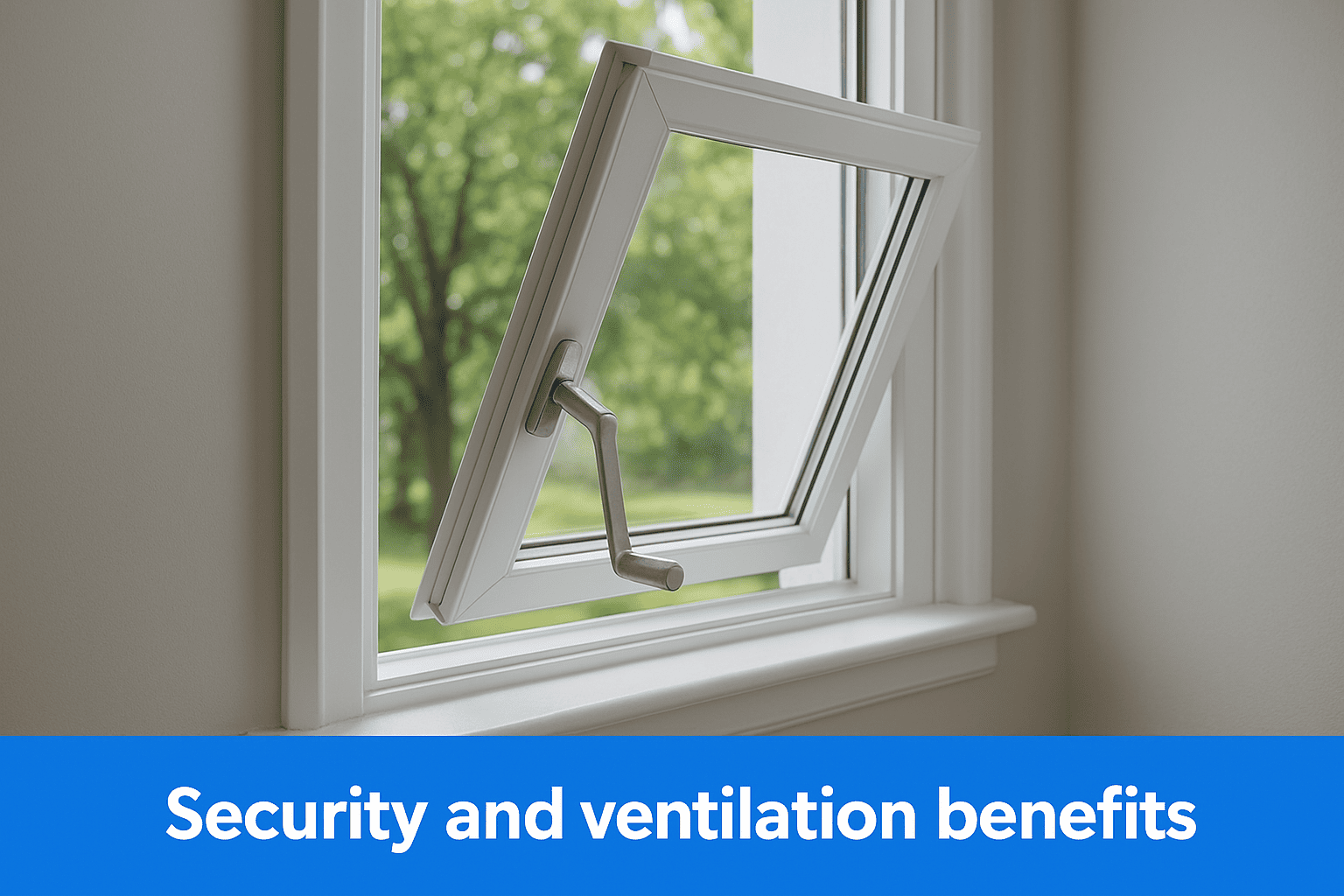
Ventilation is the other underrated advantage. Because the sash opens like a door rather than sliding, a casement window catches passing breezes and funnels them into the room, something a slider simply can't do unless the wind happens to blow straight at it. Crank open just a few inches and you get controlled airflow without the security compromise of leaving a slider unlatched.
How casements compare to other window styles
Seeing the differences side by side makes the case clearer than any single stat:
| Feature | Casement (crank) | Double-hung / Slider |
|---|---|---|
| Seal type | Compression seal on all sides | Friction-fit, gaps more likely |
| Air infiltration | Very low | Moderate to high |
| Security | Multi-point lock, no sash to force | Single latch, easier to pry |
| Ventilation | Funnels breeze into room | Depends on wind direction |
| Ease of cleaning | Full access from inside | Limited to sash range |
| Moving parts | Gear box, arm, crank handle | Balances, sash locks |
Cleaning deserves a mention too. A casement swings fully open, giving you access to both sides of the glass from inside your home, which matters if your windows are on a second storey or above a garden bed you'd rather not trample.
None of this means casements are maintenance-free. The trade-off for that airtight seal and hardware-driven operation is a mechanical system with moving parts that eventually wear, which is exactly why understanding the crank operator mechanism matters before something goes wrong. If you've ever cranked a handle that spun freely without pushing the sash, you've already met the downside of this design, and it's worth knowing what's happening inside that gear box before you call anyone out to fix it.
How the crank operator mechanism works
Open up the housing under a casement handle and you'll find a small worm gear connected to a scissor-style arm, and that simple combination is what turns a quarter-turn of your wrist into several inches of outward push. The casement windows operator converts rotational force into linear motion, gradually extending or folding the arm that's bolted to the bottom of the sash. Turn the handle clockwise and the gear drives the arm outward, pushing the window open; reverse it and the arm folds back, pulling the sash snug against the frame until the locks engage.
The whole mechanism is really just a gear box translating a spin into a push.
The parts that do the work
Every casement crank windows operator relies on a handful of components working together, and knowing their names helps when you're troubleshooting or ordering parts:
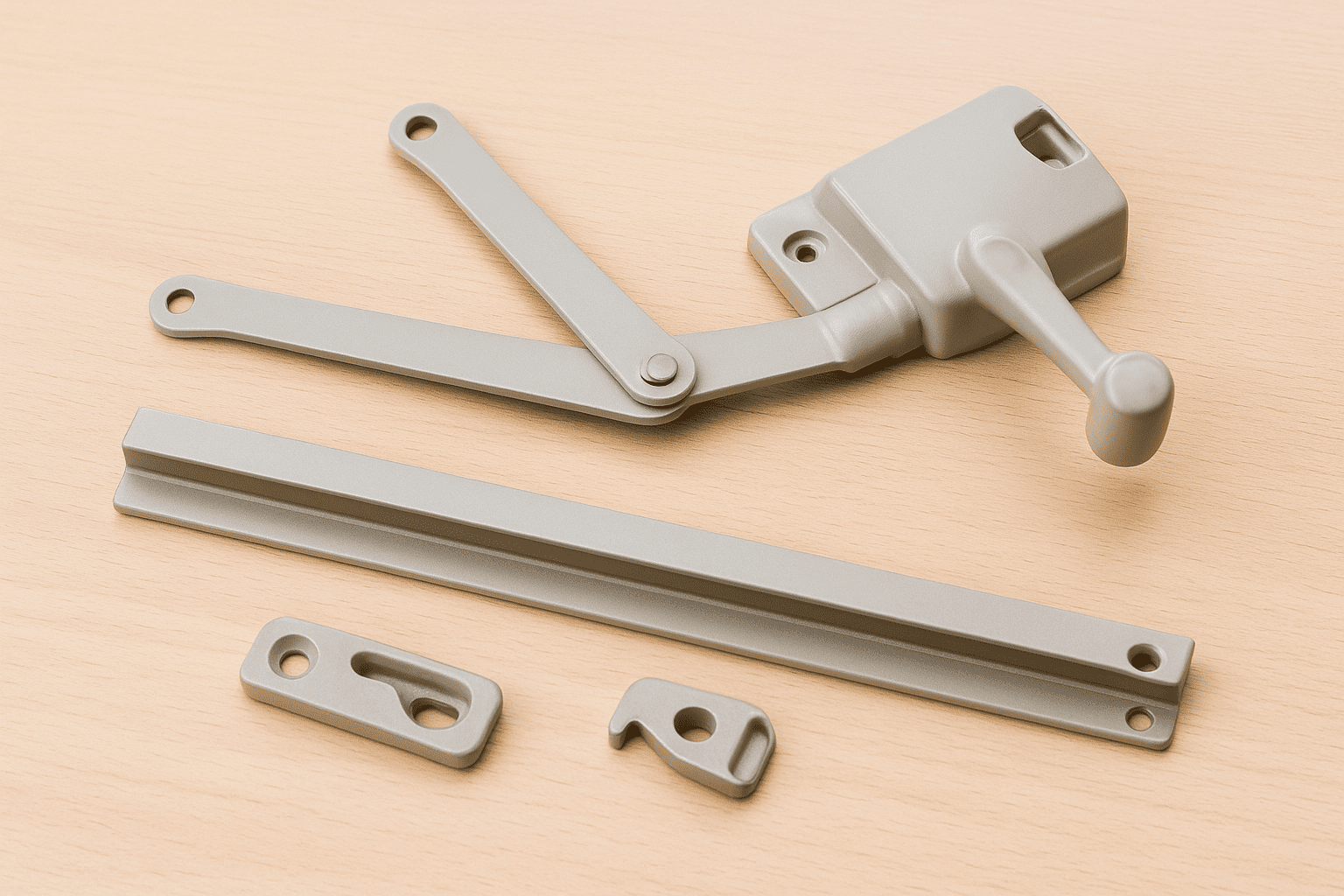
- Handle: the part you turn, usually removable for cleaning or blackout blinds
- Gear box: houses the worm gear that converts rotation into linear force
- Arm assembly: the scissor or track arm bolted to the sash
- Track: the channel the arm slides along, fixed to the frame
- Cam and keeper: the lock that pulls the sash tight against the weatherstripping when fully closed
Worn gear teeth are the most common failure point, which is why a handle that spins freely without moving the sash almost always means the gear box has stripped internally rather than something wrong with the window itself.
Split-arm vs single-arm operators
Heavier or wider sashes typically use split-arm operators, where two shorter arms share the load instead of one long arm doing all the work. Manufacturers spec these based on sash weight and height, so a taller casement window will usually carry a split-arm operator even if a smaller unit next to it uses a single arm. Regardless of which type sits behind your handle, the geometry is designed to fully retract when closed, letting the sash pull flush against the frame so the compression seal we covered earlier can actually do its job.
Jerking or forcing a stiff handle is the fastest way to strip that gear, so if you feel resistance, stop and check the track for debris before applying more force. Left ignored, a stripped gear box means the operator needs replacing entirely, since the mechanism isn't something you can re-cut or repair piece by piece.
How to operate and maintain your casement window
Running a casement window properly is simple once you know the sequence: unlock the cam handle first if it has one, then turn the crank counterclockwise to open and clockwise to close until the sash sits flush and the lock re-engages. Rushing this, especially forcing the handle past the point where the sash is fully open or fully closed, is what strips gears over time. Treat the crank the way you'd treat a stiff door hinge, with steady pressure rather than a hard yank, and the mechanism will outlast most other parts of the window.
A casement window rewards patience with the handle far more than force.
A seasonal maintenance routine
Most of the trouble homeowners run into with a casement windows crank comes down to dirt and dry metal rather than a genuinely broken part. A short routine twice a year keeps the operator moving smoothly:
- Clean the track: wipe out grit and debris with a soft brush or vacuum attachment before it packs into the arm assembly
- Lubricate the gear box and arm: a few drops of light machine oil or silicone spray, never household oil like WD-40, which attracts dust
- Check the weatherstripping: press along all four sides for gaps or compression loss that could let draughts in
- Inspect the hinges: tighten any loose screws before they cause the sash to sag and bind against the frame
- Test the lock cam: confirm it pulls the sash fully tight rather than leaving a visible gap at the latch side
Spring and autumn are ideal times for this, since you're already checking screens and storm windows anyway, and it takes less than ten minutes per window.
Signs you're overdue for attention
Ignoring small symptoms is how a five-minute fix turns into a full replacement. Watch for a handle that feels gritty or catches partway through its turn, a sash that closes unevenly on one side, or condensation forming between the glass panes, which points to a failed seal rather than the operator itself. Painting over the crank mechanism is another common mistake homeowners make during exterior touch-ups; paint seizes the gear box and hinges just as effectively as rust does, so mask it off every time.
Quiet operation is the goal, and any new grinding, squeaking, or resistance is your window telling you something's changed inside that gear box. Catching it early, while it's still a lubrication or cleaning issue, is far cheaper than waiting until the arm or gears need replacing outright.
Types of casement crank windows and operators
Not every casement window is built the same way, and knowing the differences matters when you're comparing quotes or trying to source a replacement part that actually fits. Casement crank windows vary by how the sash is hinged, how many panes make up the unit, and what kind of operator drives the arm, so it pays to know which configuration you have before you order anything.
Sash configurations
Most homes use one of a few standard layouts, each suited to different openings and rooms:
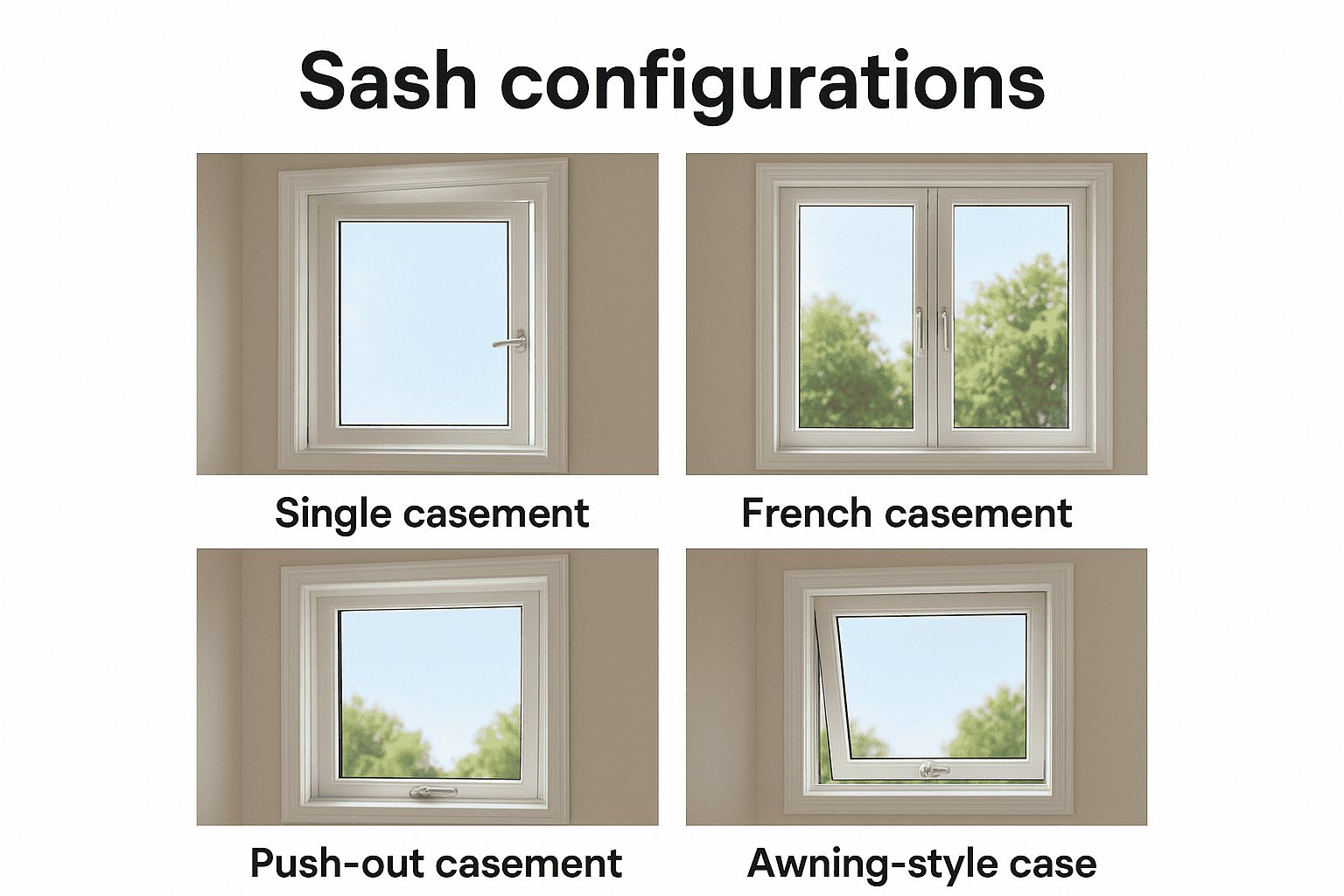
- Single casement: one sash hinged on either the left or right side, common for narrow openings
- French casement: two sashes that meet in the middle with no centre mullion, giving an unobstructed view when both are open
- Push-out casement: a simpler hinge-and-latch design without a geared operator, less common in Canadian builds because it lacks the tight compression seal
- Awning-style casement: hinged at the top rather than the side, useful above kitchen sinks or basement window wells where side clearance is tight
The hinge location changes the airflow pattern more than most homeowners expect.
French casements look striking on a front elevation but need careful attention to the meeting seal between the two sashes, since that's the one spot without a frame to compress against.
Operator styles
The casement windows operator itself also comes in a few distinct mechanical styles, and manufacturers choose based on sash size and expected wear:
| Operator type | Best suited for | Typical durability |
|---|---|---|
| Single-arm | Smaller, lighter sashes | Good for standard use |
| Split-arm (dual arm) | Taller or wider sashes | Higher load capacity |
| Concealed operator | Modern, low-profile hardware sets | Harder to access for repair |
| Exposed track operator | Older or budget windows | Easier to service and clean |
Concealed operators sit hidden within the frame for a cleaner look, which is popular on newer builds, but that same design makes DIY servicing trickier since you often need to remove interior trim to reach the gear box. Exposed track operators, more common on older Ontario homes built before the 2000s, are blunt-looking but genuinely easier to clean, lubricate, and replace without specialist tools.
Before ordering a replacement operator, note the arm length, the hand of the window (left or right hinge), and whether the sash uses a single or split arm. Mixing these up is the single most common reason a replacement part shows up and simply doesn't fit.
Repairing or replacing a casement window operator
Deciding whether to repair or replace comes down to one question: is the gear box itself stripped, or is everything else around it just worn or dirty? Casement crank windows with a handle that spins freely and produces zero movement almost always need a new operator, since a stripped worm gear can't be re-cut or patched. If the handle still moves the sash but grinds, sticks partway, or takes several turns longer than it used to, you're often looking at a lubrication or cleaning fix rather than a full swap.
If the handle spins and the sash doesn't move, you're replacing the operator, not lubricating it.
What you can usually fix yourself
A short list of issues are worth trying before you call anyone out or order parts:
- Loose handle screws: tighten with a Phillips screwdriver, often the entire cause of a wobbly feel
- Debris-packed track: clear grit with a brush, then re-lubricate with silicone spray
- Loose hinge screws: tighten to stop the sash sagging and binding against the frame
- Worn keeper alignment: adjust the strike plate slightly if the lock cam isn't pulling the sash fully tight
These fixes take fifteen minutes and no specialist knowledge, and they solve the majority of stiff-handle complaints homeowners bring up.
When you need a replacement operator
Once the gear teeth inside the box are stripped, the only real fix is a new casement windows operator matched to your existing arm length and window hand. Take the old operator out and bring it with you, or photograph the sash, arm, and any visible part numbers stamped on the housing, since matching hardware by sight alone leads to returns and delays. This is also the point where it's worth asking whether the whole window still makes sense to keep. If you're seeing fogged glass between panes alongside a failed operator, you're looking at two separate problems, a broken seal and worn hardware, and replacing just the crank won't fix condensation.
Factory-direct suppliers who both manufacture and stock hardware, rather than retailers reselling third-party parts, tend to have a much easier time matching older operators to current stock. MK Windows and Doors keeps common operator types on hand for exactly this reason, since Ontario homes built anywhere from the 1990s onward can have wildly different arm lengths and mounting patterns. When the frame itself is still sound and only the hardware has failed, a straightforward parts swap beats a full window replacement every time, both on cost and on how quickly you get your window working again.
Choosing the right casement crank windows for your home
Picking a casement window isn't just about matching the opening you already have. Casement crank windows come in enough frame materials, glass packages, and operator styles that the right choice depends on the room, the direction it faces, and how much draught or noise you're trying to keep out. Start with the basics: measure the rough opening, note which way the sash needs to hinge for the best airflow, and decide whether you want a single sash or a French pair before you look at anything else.
Matching materials and glass to the room
Vinyl frames dominate the Canadian market for good reason. They don't rot, they don't need repainting, and they handle temperature swings from minus thirty to plus thirty without warping. Fibreglass costs more but holds up better on south-facing walls that take direct sun all day. Whichever frame you pick, don't skimp on the glass package, since that's where most of the energy performance actually comes from.
A cheap frame with good glass will always outperform a good frame with cheap glass.
Here's a quick way to think through the decision room by room:
- Bedrooms: prioritise security hardware and a quiet-closing operator, since multi-point locks matter more here than anywhere else in the house
- Kitchens: consider an awning-style casement above the sink for ventilation without reaching over the counter
- Living rooms facing the street: French casements without a centre mullion give the cleanest sightline
- North-facing rooms: focus on Low-E coatings and argon fill to offset the lack of direct sun warming the glass
Sizing the operator to the sash
Wider or taller sashes need a split-arm operator, full stop. A single arm on an oversized casement will wear out faster and struggle to seal the far edge evenly, which defeats the whole point of choosing a casement in the first place. If you're replacing a window rather than filling a fresh opening, check your existing operator's arm length before you commit to a size, since that number determines what hardware will actually fit once the new sash goes in.
Budget matters too, but chasing the lowest quote often means a lighter-gauge operator that strips sooner. Factory-direct pricing lets you get commercial-grade hardware without paying retail markup twice over, which is usually the better trade than saving a few dollars upfront on a gear box you'll be replacing again in five years.
Getting the most from your casement windows
Understanding how the crank operator mechanism works puts you in a much better position, whether you're troubleshooting a stiff handle or comparing quotes for a full replacement. A casement window rewards a bit of routine care with years of tight seals, quiet operation, and a lock that pulls flush every single time. Skip the maintenance and even the best hardware will wear out sooner than it should.
Most problems with casement crank windows come down to either dirt and dry gears, which you can fix yourself in minutes, or a stripped operator that genuinely needs replacing. Knowing which one you're facing saves you money and stops a small issue turning into a full window job.
If your handle spins without pushing the sash, or you're planning a window upgrade and want factory-direct pricing on hardware built for Canadian winters, get in touch with MK Windows and Doors for a straightforward quote.