
Getting a straight answer on the cost for window replacement shouldn't feel like pulling teeth. Ask three contractors in Ontario and you'll often get three wildly different quotes, with little explanation of what's actually driving the price. That gap between vague ballpark figures and a real, usable budget is exactly what leaves homeowners stuck before they even start planning.
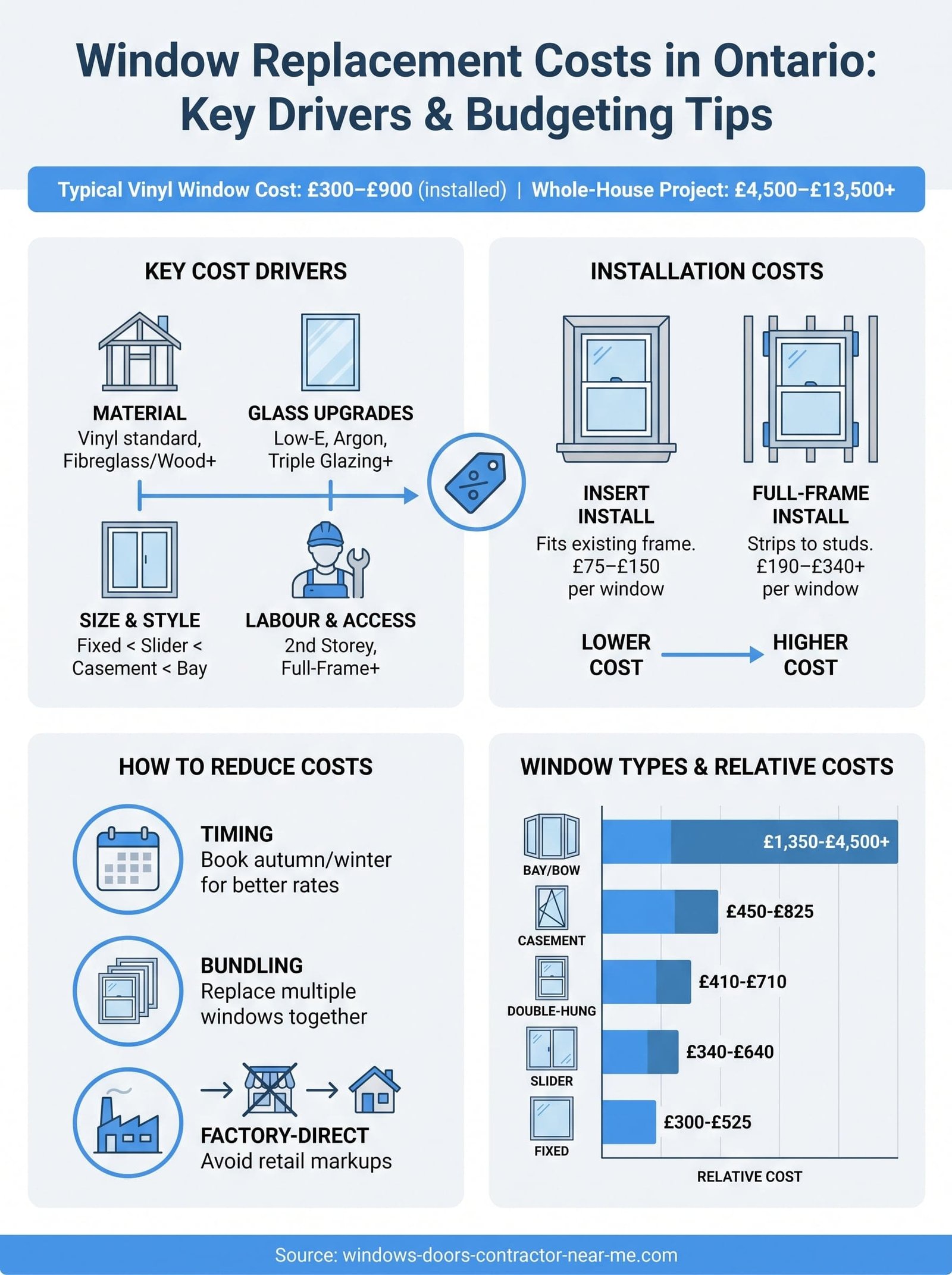
So here's the direct version: vinyl replacement window cost in Ontario typically runs between $400 and $1,200 per window installed, depending on size, style, and glass options, while a full window replacement cost ontario homeowners can expect for a whole-house project usually lands between $6,000 and $18,000 for a standard home. Patio doors and larger custom units push those numbers higher.
In this article, we'll break down exactly what makes up that price, from frame materials and glass upgrades to labour and installation, so you can see where your money goes. We'll also cover average window replacement cost by window type, what affects pricing region to region, and how factory-direct manufacturing changes the equation compared to retail markups.
Why window replacement costs vary so much in Ontario
Ask any installer why the cost for window replacement swings so widely and you'll hear the same answer: no two jobs are identical. A single-pane slider in a bungalow costs nothing like a triple-glazed bay window on a two-storey home served by our window installers in Barrie. Frame material, glass package, window size, access difficulty, and even the age of your house all stack together to produce your final number. Understanding each factor helps you spot a fair quote versus one that's padded or, worse, missing something you'll pay for later.
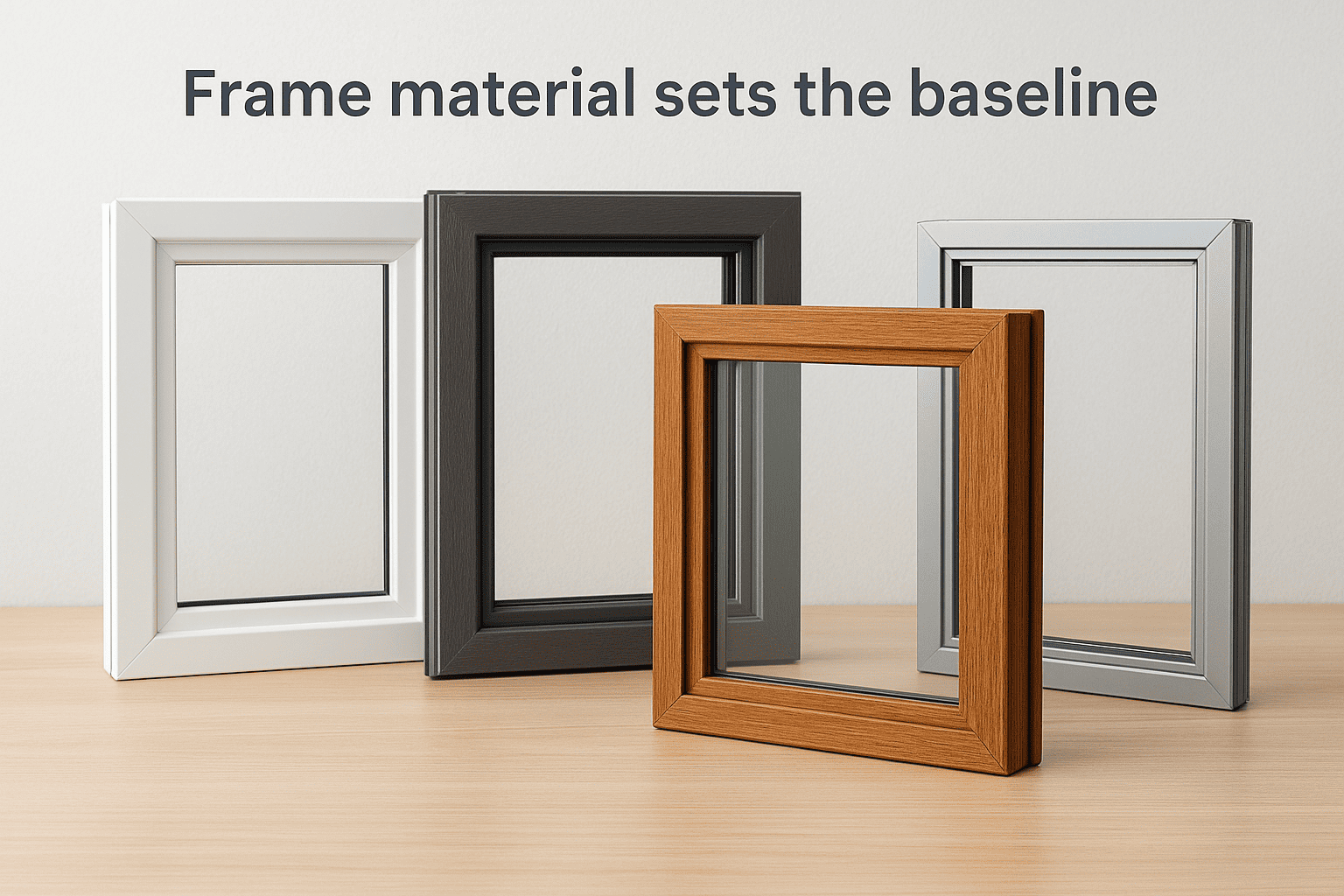
Frame material sets the baseline
Before anything else, frame material decides where your price starts. Vinyl remains the most common choice across Ontario because it balances cost, insulation, and low maintenance better than almost anything else on the market. Fibreglass and wood-composite frames cost more upfront but hold up longer against temperature swings, which matters when your home sees minus 20 in January and plus 30 in July.
| Frame material | Typical cost range per window (installed) | Notes |
|---|---|---|
| Vinyl | $400 to $1,200 | Best value, low maintenance, wide colour range |
| Fibreglass | $700 to $1,600 | Stronger, more stable in temperature extremes |
| Wood-composite | $900 to $2,000+ | Premium look, higher upkeep |
| Aluminum | $500 to $1,300 | Slim sightlines, less thermal efficiency |
Size, style, and configuration change everything
Once you move past material, window style becomes the next big driver. A standard fixed or single-hung window is the cheapest configuration because it has fewer moving parts and simpler hardware. Crank-operated casement windows and double-hung windows cost more due to their operating mechanisms, while bay, bow, and picture windows climb higher still because they require custom framing, extra structural support, and often multiple glass units working together as one assembly. A 12-foot bow window isn't priced like three separate windows, it's priced as a custom structure, and that shows up clearly on your quote.
The single biggest cost driver isn't the brand you choose, it's the size and shape of the opening you're filling.
Glass and performance upgrades add up fast
Glass is where a lot of homeowners get surprised. Double-glazed units with Low-E coating and Argon gas fill are the current standard for anyone serious about energy efficiency in Ontario's climate, and they typically add $50 to $150 per window over basic double-pane glass. Triple-glazed units, tinted glass, beveled edges, and decorative grille patterns each add their own line item, and it helps to know what glass replacement costs on its own. If security or noise reduction matters to you, upgraded hardware and laminated glass push the number higher again, but they're worth pricing out separately rather than assuming they're baked into a base quote.
Labour, access, and site conditions matter more than people expect
Beyond the product itself, installation complexity can swing your total by hundreds of dollars per window. A ground-floor window in a wall with no obstructions installs quickly. A second-storey window requiring scaffolding, a window surrounded by brick that needs re-flashing, or a frame with rot or structural damage all add labour hours before the new unit even goes in. Full-frame replacements, where the installer removes everything down to the studs, cost more than insert replacements that fit into the existing frame, but they're often necessary on older Ontario homes where the original framing has shifted or deteriorated.
Regional pricing and market conditions in Ontario
Finally, where you live in Ontario affects your quote, though maybe not as much as people assume. Contractors in the Greater Toronto Area often charge a premium tied to higher overhead and demand, while towns like Innisfil and the surrounding Simcoe region typically see more competitive pricing. Seasonal demand plays a role too: booking installation in peak spring and summer months can mean longer wait times and less room to negotiate, while fall and winter often bring better availability and occasionally better pricing from manufacturers looking to keep crews busy. Buying factory-direct, rather than through a retailer marking up a manufacturer's price, is one of the few factors entirely within your control, and it's often the difference between the low end and high end of the ranges above.
How to budget for your window replacement project
Before you call a single contractor, walk through your house and make a real list. Most homeowners underestimate how much does window replacement cost because they price one window in their head and forget the other nine that need doing too. Start with a full inventory: count every window, note its rough size, and flag which ones are single-pane, drafty, or fogged between the panes. That list becomes your working budget document, not a guess you'll revise three times mid-project.
Prioritize by urgency, not by room
Once you have your list, sort it by actual need rather than which room bothers you most. A window with failed seals, visible condensation between panes, or rotting frame is losing you money every month through heat loss. A window that's simply outdated in style but still sealing properly can wait a year if your budget is tight. This approach lets you phase a window replacement and installation cost across two or three seasons if a full-house job isn't realistic right now.
Get quotes that actually compare
Ask every contractor for the same breakdown so you're comparing like for like. A quote that just says "$8,500 for 10 windows" tells you nothing useful.
- Frame material and manufacturer for each window
- Glass package (double vs triple glazed, Low-E, Argon)
- Full-frame vs insert installation method
- Labour, disposal, and any permit fees listed separately
- Warranty terms in writing, not just verbally promised
A quote you can't break down line by line is a quote you can't trust.
Don't forget the costs outside the window itself
Beyond the unit and labour, a handful of smaller costs catch people off guard. Older Ontario homes sometimes need minor carpentry to repair rot around the frame before the new window goes in, which adds to the bill on the spot. Disposal of old windows, especially if they contain lead paint or old aluminum frames, sometimes carries its own fee. Municipal permits aren't usually required for straightforward replacements, but structural changes, like enlarging an opening for a bigger window, can trigger a permit requirement and inspection cost worth checking with your municipality or the Canada Mortgage and Housing Corporation's homeowner resources before you commit.
Build in a contingency, always
Finally, set aside 10 to 15 percent above your quoted total. Hidden rot, unexpected framing issues, or a decision to upgrade glass mid-project are common enough that a contingency isn't optional, it's standard practice. Homeowners who skip this step are the ones who end up stalling a project halfway through because the budget ran dry before the crew finished the last three windows.
Vinyl window replacement costs by type and size
Vinyl dominates the Ontario market for good reason, and once you know the replacement window cost for each of the vinyl window styles we build, you can build an accurate budget without waiting on five separate quotes. Below is what homeowners across Ontario typically pay per window, installed, for standard sizes in each category. These figures assume a mid-range glass package with Low-E coating and Argon fill, since that's what most installers, including us, treat as the current baseline rather than an upgrade.
Cost by window type
Different styles carry different hardware, framing, and labour requirements, which is why a slider and a bay window sitting in the same wall can cost thousands of dollars apart.
| Window type | Typical installed cost | Why it costs what it costs |
|---|---|---|
| Fixed/picture | $400 to $700 | No moving parts, simplest installation |
| Single/double slider | $450 to $850 | Basic hardware, straightforward install |
| Single-hung | $450 to $800 | One operable sash keeps costs modest |
| Double-hung | $550 to $950 | Two operable sashes, more hardware |
| Casement | $600 to $1,100 | Crank mechanism, tighter seal |
| Awning | $600 to $1,050 | Similar mechanism to casement, smaller sizes |
| Bay (3-panel) | $1,800 to $4,500 | Custom framing, structural support needed |
| Bow (4 to 6-panel) | $2,500 to $6,000+ | Multiple units, extensive structural work |
A bay window installation or bow window isn't one product with one price, it's a small construction project priced accordingly.
How size pushes the number up or down
Going beyond style, window size matters just as much within each category. A standard 24x36 inch tilt slider window sits at the low end of its range, while a 36x60 inch slider in the same style climbs toward the top simply because it needs more glass, more frame material, and a heavier unit to handle safely during installation. Larger openings also sometimes require additional structural bracing, particularly in older Ontario homes where the original rough opening wasn't built with today's heavier, better-insulated glass units in mind.
Why the range is still this wide
Here's the thing worth understanding before you get quotes: two windows of the identical style and size can still land at opposite ends of these ranges depending on the manufacturer, the glass package, and whether you're buying through a retailer or factory-direct. A retailer marking up a wholesaler's product by 20 to 40 percent explains a lot of the gap between what one homeowner pays and what their neighbour paid for what looks like the same window. That's precisely the markup a factory-direct manufacturer like MK Windows and Doors removes from the equation, since you're buying the same custom-built vinyl window without paying for a middleman's margin on top of it.
Window installation costs and what's included
Labour is where a lot of quotes get vague, so let's fix that. When you're comparing window replacement installation cost figures, understand that installation typically adds $100 to $300 per window on top of the unit price, though full-frame jobs with structural work push that higher. On a whole-house project, labour usually accounts for 25 to 35 percent of your total bill, which is why two identical windows installed by different crews can still land far apart on the final invoice.
What professional installation actually covers
Before you sign anything, confirm what's actually bundled into that labour line. A proper installation quote should include:
- Removal and disposal of the old window and frame
- Inspection of the rough opening for rot, mould, or structural movement
- Installation of the new unit with proper shimming and levelling
- Spray foam or fibreglass insulation around the frame to stop air leaks
- Interior and exterior trim, caulking, and finishing
- Site cleanup and haul-away of debris
- A written workmanship warranty separate from the manufacturer's product warranty
Missing even one of these items usually means a hidden cost later, either as a separate invoice or as a problem you inherit yourself.
If disposal, insulation, or trim work isn't itemised on your quote, assume it's not included and ask before you sign.
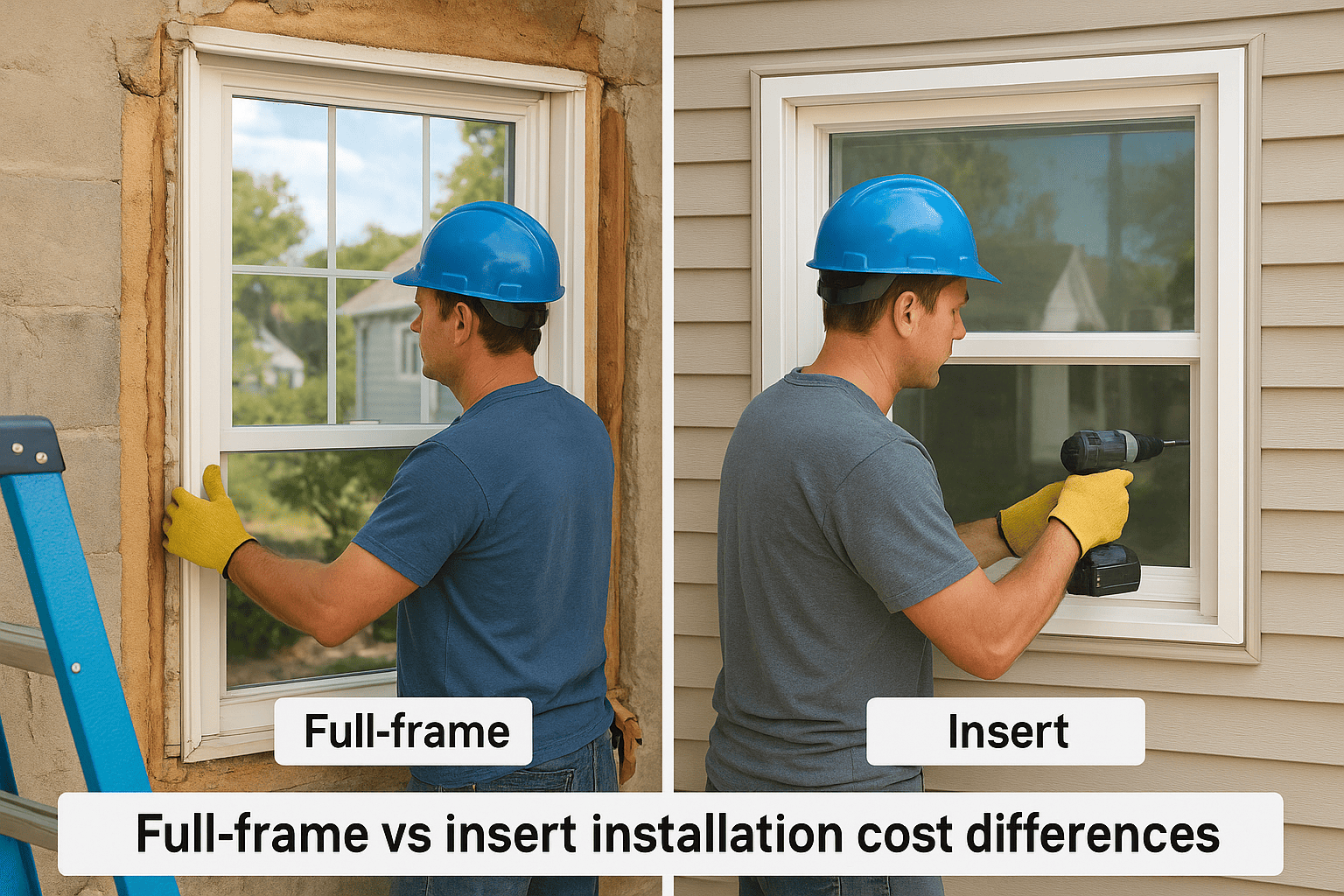
Full-frame vs insert installation cost differences
Insert installations, where the new window fits inside the existing frame, cost less because the crew isn't touching your siding, brick, or interior drywall. Full-frame replacements strip everything back to the studs, which takes longer but is often the only responsible option on older Ontario homes with rotted sills or shifted framing.
| Installation type | Typical labour cost per window | Best suited for |
|---|---|---|
| Insert (pocket) | $100 to $200 | Sound existing frame, no rot or damage |
| Full-frame | $250 to $450+ | Damaged frames, resizing, or major upgrades |
Why DIY isn't the discount it seems
Plenty of homeowners consider installing their own windows to save on labour, and while it's technically possible for a simple insert job, it's rarely worth the risk. Poor sealing around the frame is the number one cause of drafts and water damage in DIY installs, and most manufacturer warranties, including ours, require professional installation to stay valid. Our own licensed and insured installation team handles the flashing, insulation, and finishing details that determine whether your new window performs for fifteen years or starts failing within three.
How to reduce your window replacement costs
Cutting your bill doesn't mean cutting corners, it means being strategic about where you spend and where you don't. Homeowners who shave the most off their cost for window replacement usually do it through timing, bundling, and sourcing rather than by picking cheaper, lower-quality materials that fail in five years and cost more in the long run.
Time your project around the calendar
Booking your installation in the shoulder seasons, late autumn through early winter in most of Ontario, often gets you better pricing and faster scheduling than spring or summer. Seasonal timing matters because contractors and manufacturers alike want steady work through the slower months, and that demand gap sometimes translates into a discount or a free upgrade you wouldn't see in June. Watch for manufacturer promotions too, since factory-direct suppliers occasionally run seasonal offers on specific frame colours or glass packages to move inventory.
Bundle windows instead of doing one at a time
Replacing five or ten windows in a single job almost always beats doing one window a year for a decade. Bundling spreads the fixed costs, crew travel, setup, disposal fees, across more units, which lowers your average cost of window replacement per window even though the total invoice is bigger. It also means one warranty period, one disruption to your home, and one negotiation instead of five separate ones.
- Group windows by room or floor to simplify the installer's schedule
- Ask for a whole-house quote even if you plan to phase the work
- Negotiate a bundled rate upfront rather than per-window pricing
Buy factory-direct to skip retail markup
The single biggest lever most homeowners never pull is sourcing. A retailer buying from a wholesaler and marking the price up before it reaches you is standard practice across the industry, and it's the reason two identical vinyl units can carry a $200 to $400 difference per window. Going factory-direct, buying the cost of vinyl window replacement straight from the manufacturer, removes that layer entirely.
Cutting out the middleman markup saves more money than any glass upgrade you'll ever skip.
Choose upgrades strategically, not everywhere
Instead of upgrading every window to triple glazing or premium grilles, spend that money where it actually earns you something back. South and west-facing windows benefit most from Low-E coatings against summer heat, while north-facing rooms rarely need the same investment. Save the replacement window average cost you'd otherwise spend on blanket upgrades and put it into the two or three windows that genuinely lose the most heat in your home.
Whole-house window replacement cost examples
Numbers mean more when they're attached to a real house rather than an abstract range, so here's what three common Ontario scenarios actually look like on paper. These examples use mid-range vinyl with Low-E and Argon glass, standard insert installation where the frame allows it, and factory-direct pricing rather than retail markup. If you're trying to answer how much do window replacement cost for your own place, find the profile closest to yours and adjust from there.
Small bungalow, 8 windows
A typical three-bedroom bungalow built in the 1970s or 80s usually has eight to nine windows, mostly single-hung and slider styles with one or two larger fixed units in the living room. Bundling the whole job together, rather than replacing windows one at a time over several years, keeps the average window replacement cost per unit lower because disposal, crew setup, and travel costs get spread across more windows.
Two-storey family home, 14 windows
A larger two-storey home brings more variety into the mix, typically a blend of classic double-hung units upstairs, casements in bedrooms, and a bay or picture window at the front. Second-storey access adds labour, replacing the large front window carries its own pricing, and a full-frame replacement on any window with sill damage pushes the total higher than the bungalow example even though it's not double the window count.
Larger home with a bay window and patio door, 18 windows plus one door
Once a bay window, a multi-panel bow window, or a large patio door enters the picture, the total climbs sharply because those units price out as custom structures rather than standard windows. A sliding or garden patio door in particular is where homeowners are most often caught off guard by a quote that looks nothing like the per-window math they did in their head.
| Home profile | Window count | Typical total cost |
|---|---|---|
| Small bungalow | 8 windows | $6,000 to $8,500 |
| Two-storey family home | 14 windows | $10,500 to $15,000 |
| Larger home with bay window and patio door | 18 windows + 1 door | $16,000 to $24,000 |
The window count on your list matters less than the mix of styles sitting on it.
Why your quote might sit outside these ranges
Every example above assumes a home in reasonably good condition with straightforward access, so a house with rotted sills, an oddly shaped opening, or a request for premium wood-composite frames will land above these figures. On the other hand, a homeowner who bundles a full-house job, buys factory-direct, and books during the slower autumn months can often land at the low end or even slightly below it. Treat these numbers as a starting point for your own budget conversation, not a fixed price, since your final invoice depends on the specific mix of windows, glass, and site conditions unique to your home.
Getting ready for your window replacement project
By now you've got a real framework for the cost for window replacement, not just a vague number from a neighbour or a single quote you're not sure how to judge. Frame material, glass package, size, and installation method all move the price, but so does who you buy from. Factory-direct pricing removes the retail markup that inflates so many quotes, and it's often the single biggest lever available to an Ontario homeowner working within a fixed budget.
Use the ranges and checklists in this guide to build your own list, prioritise the windows losing you the most heat, and get quotes broken down line by line before you sign anything. When you're ready to turn that budget into an actual plan, request a free in-home consultation and factory-direct quote from MK Windows and Doors, built around your home rather than a generic estimate.