
Standing in a showroom comparing window styles is harder than it sounds. Every brochure claims better efficiency, easier operation, and a lower price than the next. When you're weighing sliding windows vs casement for a whole-house replacement in Ontario, the decision affects your heating bills, your view, and how well your home handles a Barrie winter for the next twenty years.
The short answer: casement windows seal tighter and ventilate better because they crank outward and compress against the frame, while sliding windows cost less upfront and suit wide openings where a crank-out sash would get in the way. Neither style is universally "better", but one usually fits your specific wall, budget, and climate priorities more than the other.
This article breaks down casement windows vs sliders across the factors that actually matter: energy efficiency and air leakage, upfront and long-term cost, ventilation and cleaning, and how each holds up against Canadian winters and summers. By the end, you'll know which style belongs on your home, and where a mix of both makes sense.
Why the right choice matters for Canadian homes
Ontario winters push window seals to their limit in a way that milder climates never do. A compression seal, the kind you find on a casement window built for Ontario homes, presses the sash into the frame like a fridge door closing, which keeps cold air out far better than a sash that slides along a horizontal track. That single mechanical difference is why the sliding windows vs casement debate isn't just about looks. It determines how much cold air seeps past your window frames every January, and how much you pay National Resources Canada's suggested heating benchmarks to compensate for it.
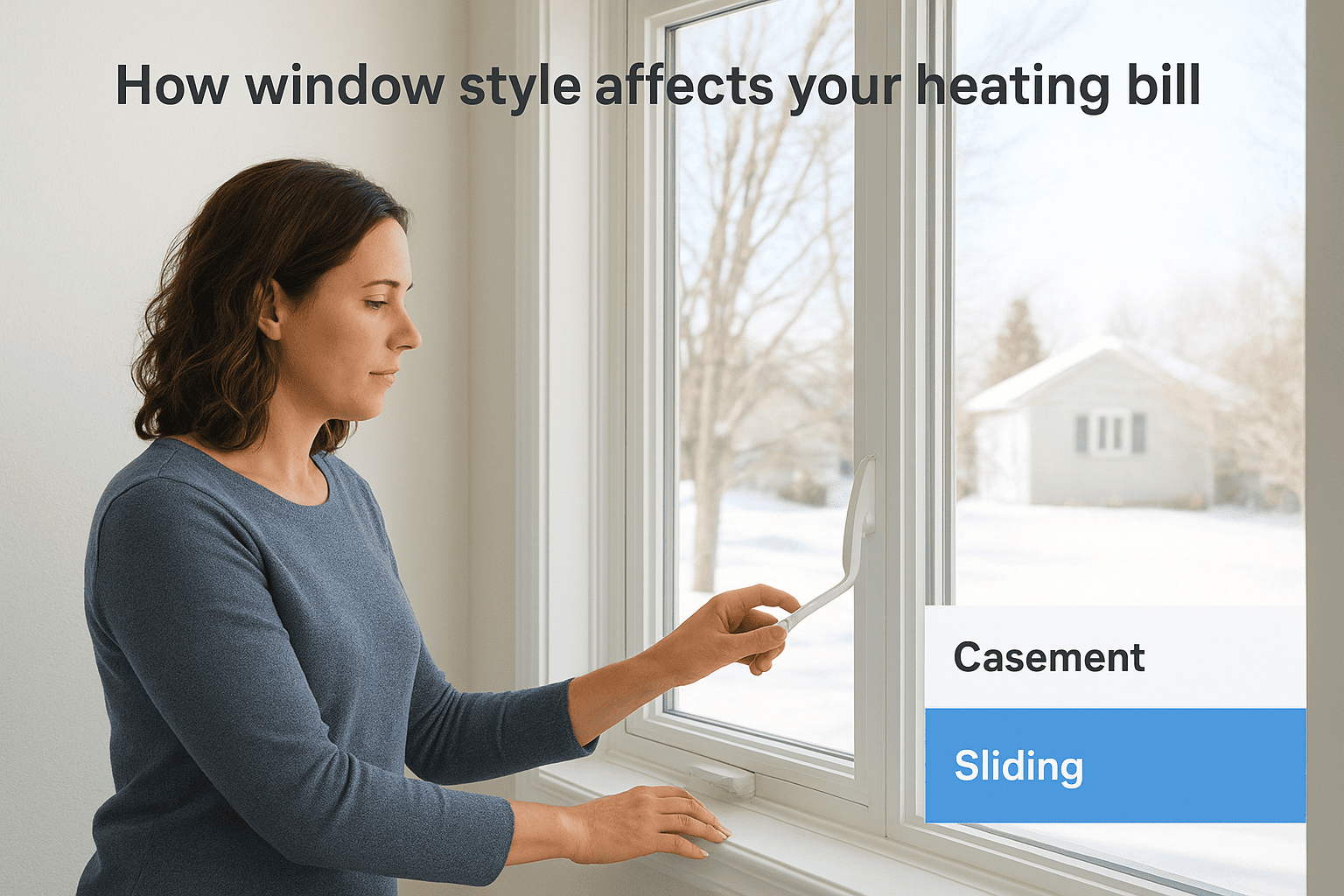
How window style affects your heating bill
Manufacturers publish an air infiltration rate for every window they sell, measured in cubic feet per minute per square foot of frame. Casement windows routinely test lower than sliders because the crank mechanism pulls the sash tight against weatherstripping on all four sides. Sliders depend on a friction fit between two overlapping sashes, which loosens slightly as the hardware wears. Here's how the two styles typically compare on an Energy Star certified product line:
| Factor | Casement | Sliding |
|---|---|---|
| Typical air infiltration | 0.01–0.05 cfm/ft² | 0.05–0.15 cfm/ft² |
| Seal type | Compression | Friction/track |
| U-factor (with Low-E, Argon) | Often lower | Slightly higher |
| Best climate fit | Cold, windy regions | Moderate climates |
A casement window's compression seal is the single biggest reason it outperforms a slider in a Canadian winter.
That gap seems small on paper, but multiply it across a whole house with a dozen windows and you're looking at a measurable difference in your monthly heating bill over a fifteen-year lifespan.
Wind, pressure and structural performance
Beyond drafts, wind-driven rain is a real concern anywhere near Georgian Bay or Lake Simcoe, where storms push moisture sideways against your exterior walls. Casement sashes seal against the frame under their own compression, so wind pressure actually helps hold them shut tighter. Sliding sashes rely on gravity and interlocking rails, which can allow water infiltration during a sideways storm if the tracks aren't maintained. This matters for structural performance over time, particularly on exposed second-storey walls or homes without much tree cover to break the wind.
Condensation, frost and long-term durability
Condensation tells you a lot about how a window is holding up. Sliding windows collect moisture along the bottom track more often than casements do, because that horizontal channel traps humid indoor air against a cooler surface. Left unchecked, that moisture cycle contributes to frame swelling, mildew, and eventually hardware failure, especially in vinyl frames that weren't built with a cold-climate profile in mind. Vinyl casement and slider windows from a manufacturer built for Ontario winters, like the Low-E, Argon-filled units MK Windows and Doors manufactures, are engineered specifically to resist that frost-and-thaw cycle rather than a generic frame designed for a milder US climate. Durability isn't an abstract spec sheet number here. It's the difference between a window that still operates smoothly in year twelve and one that's already sticking, fogging, or letting in a draft you can feel from across the room."}
How to choose between casement and sliding windows
Deciding between casement windows vs sliders doesn't need to be complicated once you know which questions actually matter. Start with the physical constraints of your opening, then layer in how you use the room, and only after that look at price. Homeowners who skip straight to cost often end up with a window that fights their wall shape or their ventilation habits for the next two decades.
Start with your wall and window opening size
Wide openings, especially anything over four feet across, favour single tilt slider windows because a casement sash that size needs a heavy-duty crank and a lot of clearance to swing outward without hitting a deck rail, shutter, or shrub. Narrower openings, particularly ones stacked above a kitchen sink or counter where you can't lean out to reach a slider's lock, work better with a casement. If your home has deep window wells or a covered porch, check that an outward-swinging sash actually has room to open before you fall in love with the style.
Match the window to your ventilation needs
Airflow direction matters more than most buyers expect. A casement window catches passing breezes and funnels them straight into the room because the open sash acts like a scoop, which makes it the stronger pick for bedrooms and stuffy upper floors. Sliding windows only open to half their total width, so you get roughly half the ventilation area of a same-sized casement.
If fresh air matters more than view width, a casement will out-perform a slider of the same size almost every time.
Factor in your budget and maintenance tolerance
Use this quick checklist to narrow things down before you request a quote:
- Opening width over 4 feet? Lean sliding.
- Need maximum airflow in a small room? Lean casement.
- Tight upfront budget? Sliding windows typically cost less per unit.
- Want fewer moving parts to maintain? Casement hardware needs occasional lubrication but avoids track debris buildup.
- Hard-to-reach location, like above an appliance? Casement cranks are easier to operate one-handed.
Working through that list before comparing quotes keeps the conversation focused on what your home actually needs, not just which brochure looks nicest in the showroom.
Casement vs sliding windows: cost, ventilation and durability compared
Comparing casement vs sliding windows side by side makes the trade-offs obvious once you put the numbers in one place. Cost, airflow, and lifespan pull in different directions depending on the style, and no single factor should decide the whole project on its own.
Comparing upfront and lifetime costs
Pricing is usually the first question homeowners ask, and it's a fair one given how many windows a full house replacement involves. Sliding windows generally cost less per unit because the hardware is simpler, with no crank mechanism or gearbox to manufacture and install. Casement windows carry a higher upfront cost but often save money over a fifteen-year span through lower air leakage and fewer hardware replacements. Here's a general breakdown:
| Factor | Sliding | Casement |
|---|---|---|
| Upfront cost per unit | Lower | Higher |
| Hardware complexity | Simple track/rollers | Crank, gears, hinges |
| Long-term maintenance cost | Track cleaning, roller wear | Occasional lubrication |
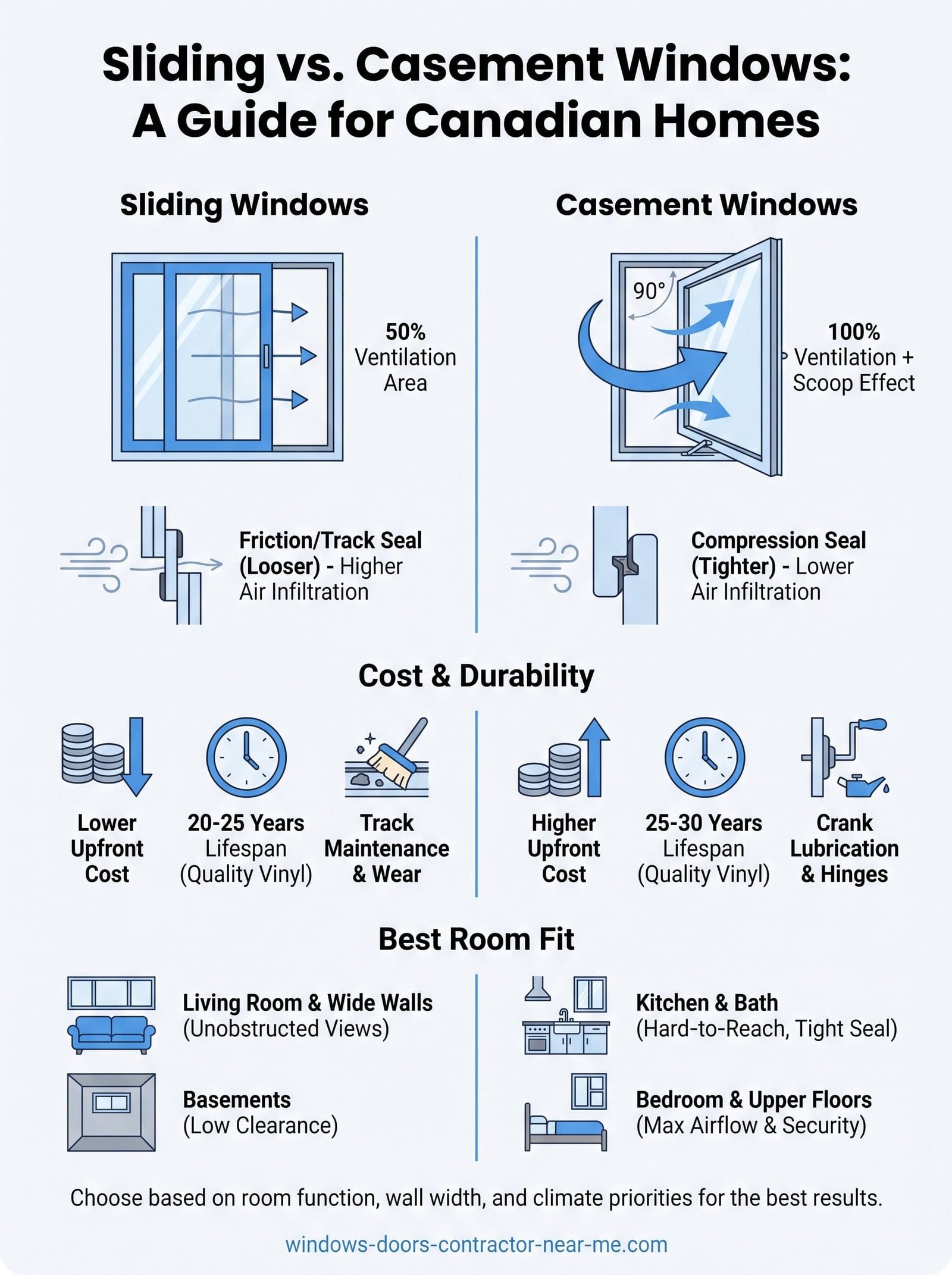
| Expected lifespan (quality vinyl) | 20-25 years | 25-30 years |
Ventilation output side by side
Opening size tells the real story on airflow. A slider only opens to half its total width because one sash stays fixed while the other travels along the track, capping your usable ventilation area at roughly 50 percent of the frame. Casement windows crank open fully, often to 90 degrees, giving you close to 100 percent of the frame as open airflow, plus that scooping effect that pulls a breeze straight into the room.
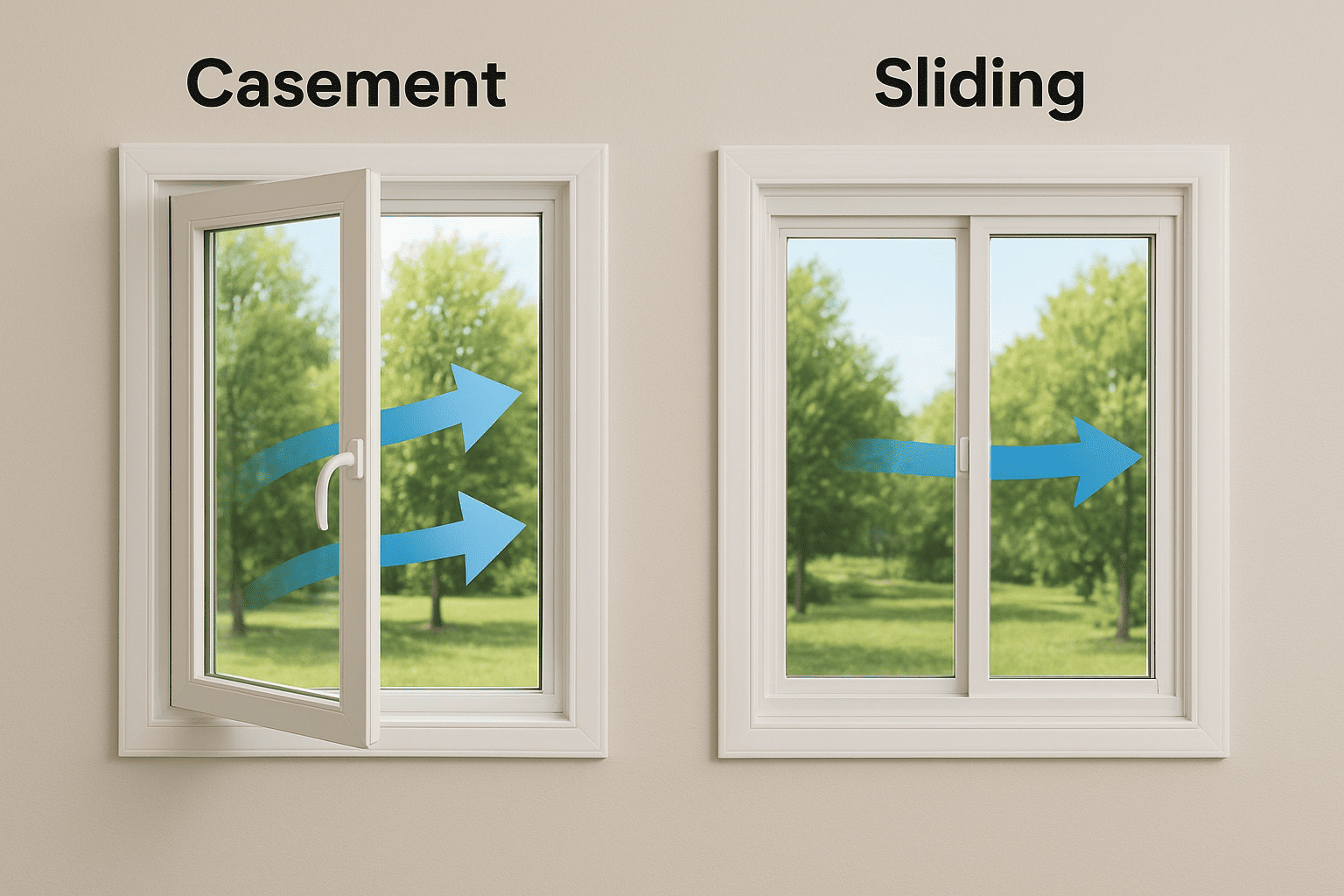
Double the openable area usually means double the fresh air, and that's exactly what a casement offers over a same-sized slider.
Which style lasts longer
Longevity comes down to how each mechanism ages under Ontario's freeze-thaw cycles. Quality vinyl casement windows tend to outlast sliders by several years because compression seals distribute stress evenly across the frame, while slider tracks accumulate grit, moisture, and wear points that eventually cause sticking or misalignment. Neither style fails quickly with proper installation, but if you're comparing casement windows vs sliding windows for a forever home, the casement typically holds its seal and smooth operation longer with the same level of upkeep.
Where each window style works best in your home
Once you understand the mechanics, matching a window style for an Ontario home to a specific room gets a lot easier. Every room in your house has different priorities, whether that's reaching a lock over a sink, catching a breeze in a stuffy bedroom, or filling a wide living room wall with light. Thinking room-by-room, rather than picking one style for the whole house, usually gets you the best mix of performance and practicality.
Kitchens, bathrooms and hard-to-reach spots
A window above a kitchen sink or a bathtub is exactly where a casement window earns its keep. You don't need to lean over a counter or climb into a tub to open it, since a crank mechanism does the work, and the tight compression seal keeps steam and cooking odours from lingering. Sliders in these spots often mean fumbling for a recessed handle you can barely reach, which is why most contractors steer clients away from them for anything positioned over an appliance or fixture.
Bedrooms, living rooms and stuffy upper floors
Bedrooms benefit from the scooping airflow a casement provides, especially on upper floors where hot air collects in summer, and a casement is often the simplest way to hit bedroom egress opening sizes. For living rooms and family rooms with a wide wall and an unobstructed view, though, sliding windows often make more visual sense, since a large casement sash needs clearance to swing and can feel bulky against a wide expanse of glass.
Pick the window style based on how you use the room, not just how the whole house looks from the street.
Wide walls, basements and mixing styles
Basements with low, wide openings and limited swing clearance almost always call for a slider, particularly where the window sits close to a walkway or patio furniture. Wide living room or dining room walls follow the same logic. Here's a quick reference for common rooms:
- Kitchen or bathroom: Casement, for one-handed operation and a tight seal
- Bedroom: Casement, for maximum airflow and security
- Living room, wide wall: Sliding, for unobstructed views
- Basement: Sliding, for low clearance and easy operation
Most Ontario homes end up with both styles once you go room by room, and that's the right outcome. Forcing one window type across an entire house rarely serves every space as well as pairing casements where airflow and sealing matter most with sliders where width and clearance take priority.
Finding the best fit for your windows
Weighing sliding windows vs casement styles always comes back to how each room performs, not which brochure photo looks nicest. Casements win on sealing, ventilation, and long-term durability, while sliders win on cost and wide-wall openings where clearance is tight. Your kitchen, bedrooms, and hard-to-reach spots probably want a casement's compression seal and airflow. Your living room, basement, or any wide opening probably suits a slider better. Neither choice is wrong once you've matched it to the actual wall and how you use that room.
Getting this right on a full house replacement means working with someone who manufactures both styles to Canadian cold-climate standards, not a generic import line. If you're ready to compare real options for your home, book a free in-home consultation with MK Windows and Doors and get a factory-direct quote built around your walls, your budget, and Ontario's winters.