
Shopping for new windows and getting three wildly different quotes is frustrating, especially when nobody explains why the numbers vary so much. If you have been searching for the cost of casement windows, you have probably noticed prices swing from a few hundred dollars to well over a thousand per window, and that gap makes budgeting for a renovation genuinely difficult.
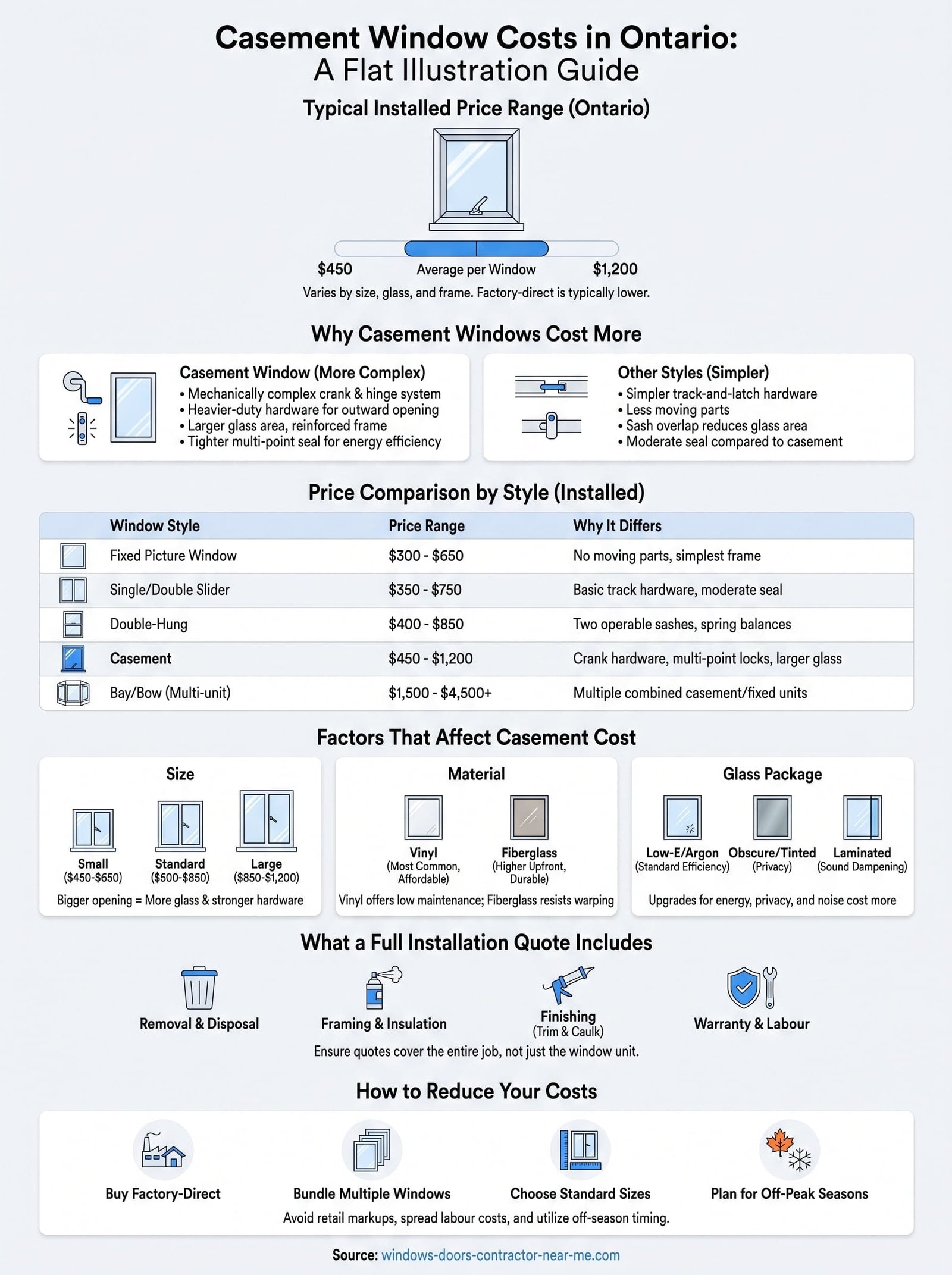
Here is the direct answer: in Ontario, most homeowners pay between $450 and $1,200 per window installed, depending on size, glass upgrades, and frame material, with the cost to replace casement windows typically running higher than new construction installs because of removal and disposal work. Wholesale and factory-direct pricing, like what we offer at MK Windows and Doors, often sits at the lower end of that range since there is no retail markup.
In this guide, we break down real casement windows price ranges by size and feature, explain what drives replacement casement windows cost up or down, and show you where you can trim expenses without sacrificing energy efficiency or durability in our Canadian climate.
Why casement windows cost more than other styles
Casement windows sit at the higher end of the windows casement prices spectrum, and there is a straightforward reason for that: how a casement window works is mechanically more complex than a window that simply slides or stays fixed in place. Every casement window relies on a crank mechanism, a set of hinges rated to hold the sash open in strong wind, and a multi-point locking system that pulls the sash tight against the frame when closed. Those extra parts cost more to manufacture and more to install correctly than the simple track-and-latch hardware you find on a tilt slider window or a double-hung window.
The hardware and seals do more work
Because casement windows open outward on hinges rather than sliding within a track, the entire weight of the sash rests on those hinges every time the window is opened. Manufacturers use heavier-duty hardware and reinforced frame corners to prevent sagging over time, particularly on larger units. The trade-off is a much tighter seal when the window is closed. Multi-point locking systems compress the weatherstripping evenly around the whole perimeter, which is why casement windows consistently outperform sliders and double-hungs on air infiltration tests.
A casement window has more moving parts and a tighter seal than almost any other residential window style, and that is exactly what you are paying for.
Glass area and frame reinforcement
Casement windows also tend to use larger glass areas for a given rough opening because there is no sash overlap eating into the viewable glass, unlike a double-hung window or slider where one panel sits behind the other. More glass means more weight, and more weight means the frame needs reinforced frame profiles to keep the sash from drooping on its hinges after a few years of daily use. That reinforcement, combined with the insulated glass unit itself, adds material cost that fixed casement windows simply do not carry.
How casement prices stack up against other styles
Seeing the numbers side by side makes the price gap easier to understand. Here is a rough comparison of average installed pricing per window in Ontario, based on a standard mid-size opening:
| Window style | Typical price range (installed) | Why |
|---|---|---|
| Fixed picture window | $300 to $650 | No moving parts, simplest frame |
| Single or double slider | $350 to $750 | Basic track hardware, moderate seal |
| Double-hung | $400 to $850 | Two operable sashes, spring balances |
| Casement | $450 to $1,200 | Crank hardware, multi-point locks, larger glass |
| Bay or bow (multi-window unit) | $1,500 to $4,500+ | Multiple casement or fixed units combined |
As the table shows, casement windows sit above sliders and double-hungs but below combination units like bay and bow windows, which are often built from multiple casement sashes joined together.
Energy performance adds to the number
Finally, casement windows are usually specified with premium glass packages because their tight seal makes the investment worthwhile. Low-E coatings and Argon gas fills, standard on our energy-efficient casement windows, reduce heat loss through the glass itself, and pairing that glass with a well-sealed frame gives you a bigger return on efficiency than putting the same glass in a leakier window style. That performance is a major reason the cost of casement windows runs higher up front but often pays back faster through lower heating and cooling bills across an Ontario winter and summer.
How to budget for a casement window replacement
Budgeting for replacement casement windows prices starts with an honest inventory of what you actually need, not a single number pulled from a quick online search. Walk through your house and note every window you plan to replace, its rough size, and whether it faces a wall that gets direct sun or driving rain, since that affects the glass package you should specify. Once you have that list, you can start requesting quotes that compare like for like instead of guessing at a whole-house total.
Get quotes for the whole job, not just the glass
Quotes should always include labour and disposal, not just the window unit itself, because contractors sometimes quote hardware alone to look competitive on paper. Ask every supplier for a line-item breakdown covering removal of the old window, disposal fees, new framing or trim if needed, and final caulking and insulation. Comparing full installed prices, rather than product-only prices, is the only way to see the real cost to replace casement windows across different quotes.
Never compare window quotes by the sticker price alone; compare the full installed cost, or you are comparing two different jobs.
Set a per-window and a whole-house number
A useful budgeting method is to work out your per-window average first, then multiply it against your full list, and add a buffer on top. Here is a simple approach that works for most Ontario homes:
- List every window to be replaced with its approximate width and height.
- Get three factory-direct or wholesale quotes, like those from MK Windows and Doors, covering the full job.
- Multiply your average per-window price by the total count.
- Add 10 to 15 percent for unexpected framing repairs or upgraded hardware.
- Confirm what warranty coverage is included before signing anything.
Plan around the season and financing
Spring and summer are the busiest installation seasons in Ontario, so booking a fall or winter installation sometimes gets you better scheduling flexibility and occasionally sharper pricing from installers filling gaps in their calendar. Many suppliers, including factory-direct manufacturers, also offer financing options or staged installation across multiple rooms if replacing every window at once stretches your budget too thin. Spreading the work over two seasons is a perfectly reasonable strategy as long as you prioritise the rooms losing the most heat first.
Casement window prices by size, material and room
Size, material, and location in the home all move the needle on casement windows cost, sometimes more than the style choice itself. A small casement in a basement bathroom and a wide casement anchoring a living room picture window arrangement can differ by hundreds of dollars, even though both are technically the same window style. Knowing which variables matter most helps you read a quote and spot where the money is actually going.
Size is the biggest single factor
Bigger openings need thicker glass, stronger hardware, and reinforced frames to stop sagging, so larger casement units always cost more per window than standard sizes. A typical bedroom-sized casement (roughly 24 by 36 inches) sits near the bottom of the range, while a large kitchen or living room casement (36 by 60 inches or bigger) pushes toward the top.
| Size category | Approximate dimensions | Installed price range |
|---|---|---|
| Small | 20" x 30" | $450 to $650 |
| Standard | 24" x 48" | $600 to $850 |
| Large | 36" x 60" | $850 to $1,200 |
The bigger the glass, the bigger the price, because size affects hardware strength, not just the amount of glass.
Material sets the ceiling and the floor
Vinyl remains the most common and most affordable frame material for replacement casement windows cost in Ontario, thanks to its low maintenance and strong insulation value. Fiberglass frames, which MK Windows and Doors also manufactures, cost more upfront but resist warping better over decades, which matters on south-facing walls that take heavy sun exposure. Wood-look composite frames sit somewhere between the two, offering a traditional appearance without the maintenance burden of real wood.
Room location changes the specification
Rooms exposed to driving rain, direct sun, or street noise usually justify upgraded glass packages, which raises the final number beyond a basic quote. Bathrooms and bedrooms often use obscure or tinted glass for privacy, adding a modest premium, while kitchens facing a busy street frequently get sound-dampening laminated glass. Basements typically use smaller, simpler casements, which is why basement replacements tend to land near the lower end of most Ontario quotes, even before factoring in material or brand differences.
What's included in casement window installation costs
Understanding the installed price of a casement window means knowing exactly what a contractor's number covers, because two quotes with the same total can include very different scopes of work. A proper installation is more than unscrewing an old frame and dropping in a new one, and skipping steps to save money upfront often costs more later in drafts, leaks, or premature seal failure.
Removal and disposal
Before anything new goes in, the old sash and frame have to come out cleanly, and that removal and disposal work is usually priced into the per-window labour rate rather than billed separately. Older wood-framed casements sometimes have rot or lead paint that needs careful handling, which can add a modest fee if your installer flags it during the initial site visit. Ask upfront whether disposal of the old unit and any debris hauling is included, since some smaller contractors quote it as an add-on.
Framing, insulation and finishing
Once the opening is exposed, installers check the rough framing for square and level, add shims or minor repairs if the wall has settled, and pack the gap around the new frame with low-expansion foam insulation to stop air leaks. Interior and exterior trim, caulking, and sometimes a fresh bead of sealant around brick or siding finish the job. A quote that skips this finishing work usually looks cheaper, but it leaves you exposed to drafts within a year or two.
A window is only as good as its installation, so the caulking and insulation around the frame matter almost as much as the glass itself.
Warranty and follow-up service
A complete installation cost should also fold in the warranty coverage on both the product and the labour, since a window that fails within a few years costs far more to fix than it saved on a discount quote. MK Windows and Doors backs its windows with a 15-year seal failure warranty and a 5-year manufacturer warranty on both products and installation, which is factored into the price rather than sold as a costly extra.
Here is a quick checklist of what a full installation quote should always list:
- Removal and disposal of the old window
- Rough opening inspection and minor framing repairs
- New window unit, hardware, and glass package
- Insulation, caulking, and interior/exterior trim
- Written warranty terms for both product and labour
Ways to reduce your casement window costs
Cutting the cost of casement windows does not mean settling for a flimsy product or skipping the parts of installation that keep your home warm. Most savings come from timing, sourcing, and bundling work smartly, rather than from buying a cheaper window that fails in five years and costs you double.
Buy factory-direct instead of retail
Going straight to a manufacturer, rather than a retail showroom that marks up product before it ever reaches you, is the single biggest lever on casement windows price. MK Windows and Doors manufactures every window style in-house and sells directly to homeowners, which removes the retail markup that inflates quotes from big-box installers. We also price-match and beat competitor quotes by up to $500, so it is worth getting a factory-direct number before signing with anyone else.
The fastest way to lower your quote is to remove the middleman, not the quality of the window.
Bundle multiple windows into one job
Scheduling several replacement casement windows together in a single visit spreads the fixed labour costs, like site setup and disposal fees, across more units instead of paying them repeatedly for one window at a time. Grouping a whole floor or every window on one exterior wall typically shaves a noticeable percentage off the per-window rate compared with piecemeal replacements done over separate visits.
Choose standard sizes where you can
Sticking to standard sizes whenever your rough openings allow it avoids the custom fabrication charges that come with odd dimensions. If a window is only slightly larger than a standard size, ask your supplier whether a small framing adjustment is cheaper than paying for a fully custom unit.
Time your project around the calendar
Here are a few practical ways to trim your final bill without cutting corners:
- Book installation in the off-peak fall or winter season for better scheduling and pricing.
- Ask about seasonal promotions or wholesale pricing tiers.
- Request a free in-home consultation before committing to a quote.
- Combine window and patio door replacement into one project if both need updating.
- Confirm warranty terms upfront so you are not paying twice for the same fix later.
Each of these steps chips away at the final number while keeping the durability and energy efficiency a Canadian home needs in an Ontario climate.
Choosing the right casement windows for your home
Getting the cost of casement windows right comes down to matching size, material, and glass package to each room, then comparing full installed quotes rather than sticker prices. You now know why casement windows carry a premium over sliders and double-hungs, what a fair installation quote should include, and where you can genuinely trim costs without weakening the seal that makes this style worth choosing in the first place. Ontario's climate rewards homeowners who invest in tight seals and quality hardware, and a factory-direct price removes the guesswork of wondering whether you paid for a retail markup instead of the window itself.
If you are ready to see real numbers for your home, book a free in-home consultation with MK Windows and Doors and get a factory-direct quote that beats competitor pricing by up to $500.